Friday, 18 June 2010

Our Blue Safari - Further North

It’s almost incongruous, sitting here in very chilly weather, thinking back to the 35 degrees on Mocambique. It’s a bit like having a helluva hangover and trying to think back on how well you felt before you got so pissed. God only knows how the folks in Barkly are feeling.

We got away from Pomene without much ado, but with a lot of sand, and made our way towards the next stop – Vilancoulos, which had evoked such stirring thoughts of tropical Africa at its best.

The road was pretty uneventful out of Pomene, just being delayed by the locals taking their cattle for walks again, and a short shopping stop at a village before the EN1. The EN1 lived up to our expectations and stayed pretty bad for much of the way. It did get better after about 80km’s and we arrived at our campsite with plenty of daylight to spare. We were spoilt for choice and took full advantage – we each took our own campsites. Despite this, we still took an inordinate amount of time to arrange who went where (“will this ever stop?” he asks) and how best to get the tents levelled – the campsite was on a fair slope. Two of the sites had baraccas and one was set up us the kitchen. Nes was there, so it didn’t take long for the stray dogs and cats to arrive for their Xmas.

So, Bluewater Beach Resort had nice grass, good army-like ablutions, a nice pub and a fantastic pool, which we spent hours in. I do not want to say – and then we went for a swim – so I won’t. We were to spend 4 nights here. No sooner had we set up, had a few beers and a swim, than a smooth purveyor of Dhow trips arrived and we were booked for a snorkelling trip the next day. On advice we ensured that this Dhow had a motor. Forgive me, but on this trip I cannot remember what we had to eat on each night, but we ate really well, courtesy of the normal diligent planning. Suffice it to say, each night we had something good to eat and something good to drink, so our spiritual wellbeing was never in doubt. The last night of each stay was at the local restaurant. Those meals that stand out in my mind will be dealt with accordingly. For a change, we did have a sufficient number of meals on a fire.

Oh, by the way, it was still incredibly warm – in fact the weather was unbelievably good. Di promised this – and she delivered.


Up bright and early, cooler boxes packed, to catch our motorised Dhow – only to find out it was just a Dhow. We were assured that the motor was working yesterday. Pete, a regular Moz traveller, says that this is SOP. Anyway, we could see the island across the incredibly blue water of this archipelago, so it shouldn’t be an issue. Add to this what we didn’t know - that the water all but disappears into a series of channels and sandbanks when the tide is out, and that without a bit of a wind, the Dhow didn’t really move much, and that the island of Magaruque was actually about 13 km’s away. Our trusty slaves (Dhow owner and assistants) threw their backs into it and rowed. With only the occasional whipping from us they rowed. And they rowed. And they rowed. They were amazingly fit and maintained an endless chatter (we did help push once or twice when the water got too shallow) Four and half hours later we arrived at the island.

We snorkelled at the small reef of the island. Our first taste of this was wonderful, somewhat limited in size, but not in clarity and colour. And, of course, the water was sooooo warm. While we did this, the slaves set up a small gazebo (4 sticks and plastic sheeting) and made lunch. We had watched our lunch staring at us from the bottom of the boat on the way out, and it was added to by some crab and squid – fresh from the water.
Despite our (my) misgivings, the lunch was a delicious seafood stew and rice – with salad. It was the taste of this that had us pondering whether we are sometimes just a little too worried about fridges and freezing (other than for beers and ice, of course) A stiff breeze (this is what coastal people call wind) and tide had come up by this time. We packed and were back at the campsite in just over an hour. Despite the missing motor, an entertaining day was had by all. Before the crew left, our supply chain manager, or quartermaster, Derek, had lined up dinner for the next night. We passed the evening in the time honoured tradition of eating, drinking and feeding the animals.
A slow morning was followed by a visit to the town of Vilancoulos, to draw money (they had quite a few ATM’s, that worked) buy some of their magnificent pau (bread) and go to the market to buy “stuff”. This was a pretty typical market and most of us found something that we wanted, including some very reasonably priced Famous Grouse and some really cheap cigarettes. Next stop was to have a look at the harbour.
The harbour was not grand, with some fairly tired fishing boats and wrecks around, but there were boats and a hotel that is busy being refurbished after many years of disuse – since the civil war. On the way down we saw a sign pointing to a Smugglers pub. How could we resist? So we didn’t, and passed a pleasant few hours sampling more local fare.
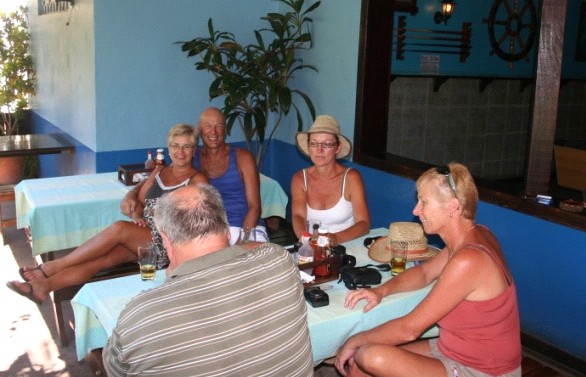
On the way back our quartermaster found his supplier – and there we were, a huge fish on the roof rack, tons of blue crab and the supplier hanging on the running boards. We were set for dinner – at a very reasonable price.

A lazy afternoon on beds and around the pool and Pete and Derek busied themselves readying the feast. Never really being much of a seafood aficionado, I made the fire. Wow, what a feast. The fish was too big for one sitting, so it was filleted and half was frozen for a later date, and we must have had about 12 crabs.
I confess to being someone who is really not given to devouring shell fish and tearing them limb from limb from limb with my fingers, or sucking the last morsels from these limbs, albeit with help from a whole lot of pliers. But, I was pretty much alone in this and the crab was attacked with gusto – with only the slurping and cracking breaking the still of the night. I must say, what I did have was really very tasty. This was followed by what was later proclaimed to be some of the best fish ever eaten. Well done Derek, with able assistance from Pete. A stunning meal.

At this juncture, it would be right to say “thank goodness” for camp helpers – to wash and clean. In truly colonial fashion, we made use of this service at every campsite. For those that might be horrified by our exploitation of the locals – hey – there are upsides to living in deepest, darkest Africa. This is one of the big ones.

The next day was, in army parlance, spent at leisure. A good breakfast, a short walk – made more interesting by Margie sinking into a crab hole up to her neck, to be rescued in the nick of time, before she sunk right down.
Okay, so it was just up to her knee and we just pulled her out, but it did sound exciting for a moment. Poetic license rules!! And then lazy time spent around the pool. You might have picked up by now that Vilancoulos did not have great beaches – they were more mud patches covered in sand, albeit also by clear blue water, so the pool was an absolute bonus. Being in the heart of fresh squid land (sea?) we all had a good evening of calamari and drinks in the pub.
We probably over stayed at Vilancoulos, but had we taken a slightly faster boat on day one we would probably have seen more of the islands, which would appear to be the main attractions of the place. However, the Dhow trip was fun and the seafood was great. Did we have a good time? Absolutely, yes!! This is what these trips are about – enjoyment and exploration.

We stopped in Vilancoulos, after a long detour via the airfield (looking for Mozambique stickers) to draw more money and buy more beer and bread and then made our way to our northern most destination – Inhassoro and Billfish Lodge.

More interesting roads were encountered and this stretch is worthy of a mention. It was my first time on a single lane tar road, made very interesting by the larger vehicles coming the other way who felt that that one lane was theirs. Anyway, we made it.

We had to take a small detour as the road to Billfish Lodge had washed away at some time, but we arrived there, quite early, on our hottest day so far. I cannot remember what the temperature was, but I do know that the men were sweating like pigs and the women were glowing like pigs. (I’m told that women don’t sweat). We checked in and grabbed a few beers to ward off encroaching dehydration. What a beautiful lodge – no camping this time – we knew that we would enjoy our two days here.
Those beers were very quickly turned into a deluge of sweat as we moved our kit into the chalet, which was really well kitted out. Each room was en-suite and air-conditioned. Not that we had lived rough, but this was stunning. The whole placed was well finished, with wooden pathways and decks, and really well maintained. We spent that afternoon lounging around the pool and considering our own great fortune to be able to do this type of thing. To give an indication of how warm it could get, one half of the pool was covered by an awning.

At this stage we also booked our next day’s excursion – a trip to see Santa Carolina (Paradise) Island and to snorkel around there and Nes starting hatching her business plan in earnest. Nothing better than a cocktail in the hot sun, planning a future!!

That night we turned on the aircon. Too cold. Set it to 27 degrees and later turned it off. We were getting cold – go figure!!

Up bright and early, down a long, steep, knee creaking flight of stairs, and onto the beach. As an aside, this too wasn’t a great beach – miles in either direction, but covered in seaplant leaves. Today we have 20 km’s to go to the island. Thoughts of time and the Dhow kept intruding, but half an hour later on the rubber duck and we were walking onto the beach of Paradise Island (local name), but also known as Santa Carolina of Survivor South Africa fame.

Juan (I think that was his name) dropped off the lunch “stuff” and we went around to the abandoned hotel on the island. This was amazing to see – yet another hotel that came to grief during the civil war. Juan was a mine of information. The hotel took up much of the island, with beautiful views from each room. The whole layout was evidence of the much better, genteel times that Mocambique had lived through, and the people that it attracted and entertained.
Even Bob Dylan had played and stayed here. Much of the hotel was crumbling and it was evident that this would not be a simple restoration job. We found out that this had been bought by arabs whose plan is to demolish it and start again. If this does happen, we wondered whether we might be amongst the last people to visit this island freely. If that is the case, and you’re up that way, this island is a must see. Not to go and see a crumbling hotel surely?
Nope!! The beaches were stunning, but the best parts were the reefs around the island. We snorkelled at two spots. The 1st was in a protected cove – the water was shallow, but the coral was unspoiled and colourful, with a huge variety of fish that were completely un-fazed by us being there. A smallish white-tip shark even crossed the reef and came pretty close to Margie to feed. The water was impossibly clear, and the white reflection of the sand created the feel of a tropical paradise – even sitting on the boat we were able to take clear pictures of the fish in the water. After a few sarmies in the shade on the beach we went to another spot on the other side of the island. The water was deeper here and the effort was a bit more with the tidal wash, but it was a massive coral bed.
There was just so much to see, fish, coral, huge clams, shells and so on. The variety was mind boggling. It was unspoiled, unmarked and magnificent. This is amongst some of the finest snorkelling that we have done – and we include Madagascar, Mauritius and Zanzibar in this comparison. Of all of them, this is  the only place where the coral hadn’t suffered from human lack of thought. I just hope that, as Mocambique starts finding itself and places further north start opening up again, that this type of environment remains unspoiled.

We had only taken this one short excursion and it was worth going to Inhassoro just for this. There were other trips to be had which, apparently, are just as good. If you’re in that neck of the woods, make this a destination. Billfish Lodge itself is part of that attraction. We were well looked after, and our evening meal of seafood (very reasonable prices) and a full breakfast the next morning just rounded our stay out nicely.

This was, unfortunately, the turnaround point of trip. We were to head south again.

And this is us, looking a lot more tanned and relaxed.


Wednesday, 09 June 2010

Our Blue Safari - White Sand, Blue Sea

Months in the planning, and months of anticipation, days of purchasing and packing, a long trip from PE for Pete and Margie and we were finally off.

The Pike’s got away at 04:00 on Sunday 21 March – followed closely by the rest at 05:00. And no, this was not because the Prado was slower!! There must be daylight savings slightly east if us that we didn’t know about.

Be that as it may, we made our fairly leisurely way to the border post. Here it is important to remember that, in writing these accounts, I always resolve to report positively. With Juju, Bob, Eugene, the Lion’s Super 14 efforts etc. there is more than enough negativity around – I refuse to be a part of that.
At around lunchtime we passed, with little fanfare, out of SA with help from the SA border officials who were clearly overworked and finding the day very long. We were assisted through the Mocambique side by a number of energetic fellows who insisted on helping us and then by a customs official who signed our vehicles through with no delays. We showed our appreciation for this assistance with some cash. Ahhh, capitalism is a wonderful thing.
From there to the Spar on the outskirts of Maputo to stock up with Mets and beer - we believed that we might need both for our trip. This belief was correct. Going through Maputo was the only time that we were stopped by police on our entire trip. They quickly worked out that the 3 vehicles were fine, and that we didn’t understand a word they were saying and let us carry on.

By this time we were starving and, knowing that Zona Braza (our first stop) was quite a way away, we stopped at Ultra City for a very welcome Prego and our first 2M (pronounced doish M). ‘twas beautiful.

Then through Xai-Xai – Oh - my - WORD – what happened to these roads? Moz might just have discovered the cheapest way to do traffic calming through their cities – and beyond – potholes!! The road beyond Xai-Xai was a revelation. They were fixing it, and the detour on the side was thick with sand, and almost a one way. We had a moment or two of consternation when some insistent trucks nearly had one of our number over the side. We arrived at the Zona Braza turnoff, and that road was in better condition that the EN1. After a few km’s of a narrow, sandy road, we arrived at Zona Braza, comforted in the knowledge that our 4x4’s had got us there – only to find that our 4 neighbours has gotten there in a Citroen Xsara-Picasso.

Let’s talk quickly about the roads, and then never mention them again. I’ve already mentioned some of it. There were some incredibly bad patches along the main road. So much so, that the side roads tended to be better than the main EN1. So, around Xai-Xai, Maxixe and a little north of Vilancoulos made sure that you kept your wits about you. The shoulders were often used in favour of the badly potholed tar. They made sure that you kept your wits about you, and that you tied everything down properly – there sure were bumpy parts. However, there were signs of work on the roads, by the Chinese, and this work heralds a great change. By all appearances, this will not take as long as you would think. Between our outward and return journey, there were long stretches of positive change. Maybe next year, most of this will be done. It sure will change the whole experience – as long as they leave the side roads for off-road vehicles.

We had dawdled a bit in Maputo, so it was dark when we arrived and didn’t immediately form impressions of the place. Over a few beers on the deck we flipped coins to see who would share, and who would be the honeymoon couple. The Pike’s won and we moved vehicles and trailers to the chalets. Trying to reverse my trailer into position we found that the trailer braking system doesn’t allow you to reverse, uphill, in thick sea sand. Never mind, our neighbours offered to help get the trailer down the slope. There was a moment of panic as the trailer started to run away – headed for a very steep descent into the dunes!! Quick thinking (luck) allowed us to steer the wheel into a retaining pole and stop it. It stayed there for the duration.

By now you would have realised that we weren’t camping, but in chalets. The B’s and N’s in a nice big one overlooking the ocean and the P’s in a quaint smaller one – with the kitchen a small thatched area separate from the bedroom. We unloaded the essentials, had dinner and a few drinks and retired to bed after a fairly long day. 2 nights ahead in Zona Braza. This was great planning - to allow us to get into the rhythm of Mocambique – an altogether different rhythm to that which we are used to. No prizes for guessing which is the more enjoyable.

Oh my word, but it’s warm. Down an easy hill for our first swim in the sea, wallowing in the water like whales. Magnificent weather, warm water – an idyllic morning, the first of many to come. Everybody was in their element. Two of us struggled a little with “just relaxing” and found a few things to keep us occupied. We’re going to have to find a tennis ball, or something, for these lazy days.

Between us arriving on the beach and leaving there was some type of dramatic earth movement – perhaps a slipped fault or something. The easy hill that we came down had morphed into a Killi type climb to get back up. Geez – I need a beer! Lo and behold, at the top of the summit was a bar, and ice cold 2M’s – how serendipitous. 6 newly burned people had a lazy lunch in the P’s little kitchen gazebo, with a number of 2M’s (see, I told you we needed to buy them) followed by an afternoon snooze and a great steak braai that evening.
Only 346 Km’s to go Pomene. We were really excited about this leg. We had tried a few years back, but Pomene had been washed away. We had a decent breakfast, thank goodness. 346 Km was to prove a little longer than anticipated on these roads. Driving is thirsty work, so we stopped at a local bar in Inharrime – what a magnificent lagoon - for a much needed beer, and in Maxixe again for some much needed food and drinks and then onwards to Pomene. The 1st 30 km’s or so were normal dirt as we wound our way through villages, slow traffic and cattle being taken for a walk. They all had leashes, so we assumed they’re like domestic pets, with the upside that you could eat them when they didn’t behave.

At the last little village the P’s picked up two forlorn Portuguese tourists trying to make their way to Pomene. They were really lucky that we met them when we did – it could have been a long wait. The last bit in was through a reserve, the dunes and some mangrove swamps. What a great drive. We had to let the tyres down a bit, but made it easily enough – though it may have proven tricky in anything but a 4x4.

It was getting dark when we arrived, but light enough to see the incredibly blue water and incredibly white sand. Oh boy!! More wonders await. Checked in and had to stop a very committed Jorge from giving us a whole tour before we set up camp. Despite the long break from camping, the only challenge, as per usual, was in where to put the bloody tents!! I guess this will never end. So, after much movement, backwards and forwards, we found our spots and pitched, all beds facing the sea. In this backwards and forwards, disaster befell us!! More on this later. Erection happened mostly in the dark, with a few muffled curses and sweat dripping. No harm, no foul, we were done. There was a Barraca on our site which became the kitchen. We had a somewhat disjointed dinner and drinks as we were all in and out making our arrangements, organising tents and beds and then a cold shower. No problem, it was really warm.

Opened our eyes – blue sea, white sand, blue sky, white butt – Oi – get out of my narrative!! Two wonderful beach days beckon. And that’s what they were. We still haven’t managed to find a tennis ball, but we will manage. The beach was pretty much a step from the campsite. In fact, we were camped on beach sand - beautiful, white beach sand. The weather was spot on, the sea a light blue on and a few umbrellas, chairs and the inevitable cooler box, and there we were. While lazing in the sun in the shallows the words of Winston Churchill came to mind – “never have so many words been spoken by so few in such a short space of time” – or something to that effect. Margie and Nes were the primary culprits, but there were some other sporadic contributions.

The second afternoon saw us retiring to the pool as the wind came up. A few beers and snoozes in the chairs were great for recharging batteries. That evening saw the guys dragging the ladies along to fish in the lagoon. Derek’s first cast saw his little rod (small fishing rod - behave already) was broken at the tip. Not to worry, he’s got a big rod. Let’s throw that in with the live bait that Pete caught. Bait up, throw – bugger, another broken rod. That little disaster I spoke about earlier – it appears that Derek’s rods ended up underneath more than one set of wheels in all the camp setting up. Not being luckiest fisherman alive I offered my rod up to his cause. Didn’t really change anything, that rod still hasn’t caught a fish!! This despite the fact that, for Pete and Derek, the fishing bug had bitten and they gave it a bash early the next morning again.

That night we had a fantastic meal in the restaurant – all of us opted for really fresh, delicious seafood. Despite the sundowners that we had, witnessing a wonderful sunset, and me drinking Chivas, the bill was incredibly reasonable – almost cheap. ‘twas a wonderful evening. We retired, replete and relaxed, to take up the next part of the journey. Pomene will definitely see us again.


For some reason I don't have a sunset picture of Pete and Margie - but they looked pretty much the same in any light (sorry Newtons - this'll have to do for now)

Oh yes, and I even managed to buy a Frisbee when we settled our bill.

Still another few stops on the way – stay tuned!!

Wednesday, 09 December 2009

Liuwa Plains - Going home was also fun

The Liuwa Plains were now done at dusted and it was time to make our way home. We got a good start in the morning to arrive in Mongu at around lunch time. Although I’ve glossed over it, the trip out of the Plains was as much “fun” as going in. If possible, the roads seemed to be even worse – maybe we were going against the grain. After a couple of wrong choices on multiple choice tracks, by the time we got to Mongu I was starting to suffer from a serious sense of humour failure.


Anyway, we made it to Mongu in one piece and decided that, as efficient as the Mutoya Camp was, that we’d rather give it a miss and make it as far as we could in that day without ending up driving in the dark. So we gave it horns and headed for Sioma Camp (courtesy of T4A). The road from Mongu to the Kalangola ferry also felt worse than on the journey to Mongu. It is possible as we had had fair bits of rain since our arrival. However, after all of these roads, the one from Kalangola to Sioma (which we had also traversed on the way out) seemed almost like a highway.

We drove passed quite a storm on the way, with the most magnificent rainbows. The non-die-hard campers were starting to think the chalet route again. Upon arrival at Sioma Camp (http://www.siomacamp.com/) negotiations were quickly dispensed with, over a beer, and chalets were chosen. This was made easier by the fact that the actual campsite had suffered some storm damage, as had the reception and bar. But probably even easier by the fact that it had been one helluva day. 294 Km in nearly 11 hours – going pretty much as fast as we possibly could – with limited stops. At the same time we arranged for a trip to the Sioma Falls, which were nearby.

That night we again ran into Francois and Charl of OpenAfrica (http://www.openafrica.org/ ), and spent a really interesting evening discussing the Plains, Zambia specifically, their mission and Africa in general. This brief encounter reiterated my earlier impression – this is something worth keeping an eye on.
The day had been hectic, so the get together wasn’t that late. We retired to our chalets, with satin sheets and pillows – and quickly got rid of them. Satin in the bush is just so wrong – can’t imagine what they were thinking.

After Popa Falls in the Caprivi, I was hoping that the Sioma Falls were something more. It was quite a boat ride there, with a drop-off and short walk for the boat to traverse the rapids, and then a longish walk later to get to the Falls themselves. The advertised “20 minutes to the Falls” was considerably longer, and the walk conveniently never mentioned. Be that as it may, the falls were a revelation and definitely worth the trip. In fact, if you’re in this neck of the woods, they’re a “must do”.

After everyone photographed them from every angle we made our way back, had a swim in the Zambezi and a very near mishap in the rapids. Thanks to the pilot it was negotiated with just a few raised pulses and no other harm done.
There were a number of lodges along this stretch, many of which appeared to be abandoned or falling apart. This was borne out by feedback from locals who said that Gavin Johnson (of Transvaal, Sharks and Springboks fame) was really the only person managing to make this stretch work as a tourist destination. We would also argue that Kabula Lodge was working, but not making a mint.

Although Sioma Camp has all of the right ingredients, sadly, our experience there would suggest that they too will follow the route of the others unless something is done. (Anybody want to buy this with me?)

After that, a short trip to my personal favourite, Kabula Lodge, passing by the boom, now unmanned as it was a Sunday. Go figure 

Fuel was starting to get a bit tight at this stage, but it looked as if all of us would make it to Katima the next day.

We celebrated our return to Kabula with a few beers. We had chosen to camp in their stunning grounds this time. A word to the uninitiated, putting up a dome tent while marginally under the influence is not a quick affair. Simon and Ted (who were in a chalet again) did little to help the situation while they watched – preferring a few words of encouragement mixed with derision.

We went for a short fishing excursion to try to relive the glory of the earlier part of the trip. We managed to hook absolutely nothing – my record is intact.

The next day we made our way out of Zambia. I, personally, felt very sad to be leaving the Zambezi Valley. You feel almost as if you’re leaving a part of yourself there – to pick it up when you come back. There seems to be an acceptance that you will do so. It is such a beautiful part of the world and has so much going for it.

That’s it then – leaving Zambia and retracing our steps via Katima, refuelling there with some relief, via a quick stop in Kasane and over-nighting in Elephant Sands and then Kwa Nokeng – boring tar all the way to home. Border stops all the way were a breeze and accomplished with the minimum of fuss. The only change was carrying a monumental hangover from Elephant Sands to Kwa Nokeng – a very heavy extra passenger. This was the result of over doing Simon’s “Mafunyane Xmas Party” with a few other travellers.

Now for my impressions and observations;
Zambia
Bearing in mind that we only did the very West of the country, bordering on Angola, this shouldn’t be considered as part of the definitive guide to Zambia – and should be recognised as my own humble opinion. This area has got 4 major things right; the absolute beauty of the place and its surrounds, the friendliness, industriousness and hospitality of the people, the cleanliness outside of major centres and their cell phone network. It appears to be incredibly poor, but you could pick up a signal in the most unlikely places – including the Sausage Tree in Liuwa.

Much of the industry, or lack thereof, appears to be driven by the state of the roads. There is just no easy way to get to this part of the world and very few other vehicles are seen. Those that you do see seem to be Government Department vehicles, or road works / aid vehicles - many driven by Chinese - they’re everywhere. Initial impressions suggest that the state of the roads is as a result of laziness and lack of foresight. It is not! When you see what the effect of water is on the flood plains, and you see the absolute lack of resources in this area, you begin to understand why they are that way. The hardship and lack of opportunity that the state of these roads imposes on the people suggests that they would have it another way if possible.

Barter is more popular than money in this area. Most people would prefer to be paid in goods than money - because there is nowhere for them to spend it. The cost of transport to shops would be prohibitive. We heard the story of 2 young men walking 65 km’s to buy something. They then had to get back.

But there appears to be something even more disastrous. Being in rural Africa you really become aware of the effect of Aids on this continent. We saw very few people between the ages of 18 and 40, and some of the smaller towns are nearly empty. It is estimated that between 50%-60% of the people have Aids. Given this situation we were very surprised by the lack of clinics and health services in the region. They only appeared to be available near the major centres. Given the state of the roads, they will have no effect on the rural people.

Despite the apparent poverty, or more correctly, the lack of means, we never felt unsafe or threatened in any way – even walking around in Mongu. It puts our own country, where crime is blamed on apartheid and poverty, in a very negative light. Despite the fact that there are huge power lines in the country, none of this seems to make its way to the rural people. They have to fend for themselves and draw water from the rivers - and they're happy. Makes you wonder about our service delivery protestors. Maybe the bush makes people happy?

Other than in the Liuwa Plains there was no game!! And Liuwa plains could have supported a lot more than it does. No monkeys, no baboons, no buck – and so on. My guess, and it might be the wrong one, is that the locals eat bush meat as a dietary supplement. This spells disaster if they’re trying to attract foreign tourism. Foreign tourists want the Big 5. What is heartening is the land that they’re putting aside for reserves and the work that some international organisations are doing to try to reintegrate game into the area – it certainly lends itself to this. The trick will be to show the communities that it is in their interests to work with these initiatives – and that is part of where Open Africa comes in. (if you do nothing else – read the “Founder’s Message” http://www.openafrica.org/page/about )

This made absolutely no difference to my trip. I had an adventure and saw the Wildebeest gathering – anything else would have been a bonus.

Would I go back to visit this part of Zambia? In a heartbeat – I loved it.

The Trip
I thoroughly enjoyed every minute of the trip, despite the roads. However, if I went back to Liuwa Plains it would have to be part of a longer journey. It is worth seeing, but I doubt that I would do that as an only destination again. Too much hard work for 4 days.

Our end itinerary was right, and I don’t believe there are too many changes to make to that for the trip to work again.

In the beginning I missed the trailer. Upon reflection you could pull a trailer there, but I don’t think that I would – if that was the only destination, or unless the stay was longer. The vehicle, campsites and packing worked and got easier as we went along. It is not as easy as the trailer, but it’s definitely manageable. Some stops for lunch were probably not as hygienic or aesthetically pleasing as usual, but they worked. The dome tent worked like a charm and I will never contemplate the purchase of a rooftop tent. From my point of view it unnecessarily restricts your movement, particularly when you’re in one place for more than a day.

The only things that we had to top up on were bread, beer and whisky. All to be expected, so no loss. I would plan my fuel for a little more leeway than I did.

Simon was a great guide again and his food kept us going. I will travel with Mafunyane (http://www.mafunyaneadventures.com/), Ted and George again. They really added to the texture of our trip. I certainly know more about birds, from Kobus and Debbie, than I did before.


Dave, despite your nervousness in the beginning and the fact that you caught the Tiger you were a great co-driver. I thoroughly enjoyed having you along for the ride. We had great fun and many many laughs and irreverent moments. If I’m ever in need of a co-driver again, I’ll have no hesitation in calling.